
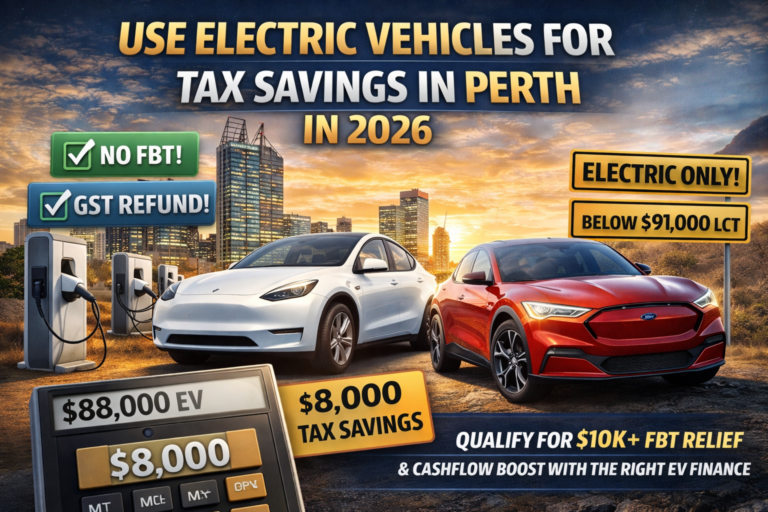
For Western Australian business owners, the debate over Electric Vehicles (EVs) has shifted. In 2024, it was about “Range Anxiety” and saving the planet. In 2026, it is almost entirely about Tax Arbitrage.
With the Federal Government’s FBT exemption fully matured and the specific “sunset” on Plug-in Hybrids (PHEVs) now in effect, the financial case for a pure electric fleet in Perth is stark.
If you are running a fleet of diesel utes or sedans for your sales team, you are likely paying a “compliance premium” you don’t need to pay. Here is the technical breakdown of how Perth businesses are using EV finance to legally strip thousands of dollars from their tax bills.
1. The FBT Exemption: The “47% Discount”
This is the single most powerful line item in fleet finance today.
Under standard rules, if you provide a car to an employee for private use (or if you are a director using a company car), your business must pay Fringe Benefits Tax (FBT). This is taxed at the top marginal rate (47%).
-
The Diesel Reality: A $70,000 diesel SUV used for private trips could cost the business an extra $10k–$15k annually in FBT liabilities.
-
The EV Reality: A $70,000 Electric Vehicle (battery only) is FBT Exempt, provided it falls below the Luxury Car Tax (LCT) threshold.
The 2026 Nuance: Crucially, the “Plug-in Hybrid” (PHEV) loophole closed on April 1, 2025. If you buy a PHEV in 2026, you do not get the exemption (unless you have a grandfathered lease). To get the tax break now, you must go full Battery Electric (BEV) or Hydrogen.
2. The Luxury Car Tax (LCT) Limit
To qualify for the FBT exemption, the vehicle’s value must be below the LCT threshold for fuel-efficient vehicles.
-
The 2025/26 Threshold: Approximately $91,387 (Indexed annually).
The Strategy: If you buy a Tesla Model Y Performance or a Ford Mustang Mach-E that sits under this cap, the vehicle is FBT-free. If you buy a luxury EV that costs $95,000, you lose the entire FBT exemption, not just the portion above the threshold.
-
Perth Fleet Tip: We structure fleet loans to ensure the “Dutiable Value” stays under this cap. Sometimes, opting for the mid-spec model and adding aftermarket accessories after delivery (paid via cash flow) is the difference between a tax-free asset and a tax burden.
3. Financing the Infrastructure: The “Bundled” Loan
One of the hidden costs for Perth businesses is the charger. Installing a DC fast charger at your Wangara depot or Osborne Park office is not cheap.
The Finance Solution: Most specialist lenders now allow us to “bundle” the cost of the charger and installation into the vehicle loan.
-
Example: You buy a $60,000 EV and a $3,000 charger install.
-
Structure: We write a Chattel Mortgage for $63,000.
-
Outcome: You get the asset and the infrastructure in one monthly payment, and you can claim the GST on the entire amount upfront.
4. GST & The “Chattel Mortgage” Advantage
While Novated Leases are popular for employees, for business owners, the Chattel Mortgage remains the king of EV finance.
Why? GST Recovery. If your business is registered for GST, buying an EV via a Chattel Mortgage allows you to claim the GST Input Tax Credit on your next BAS.
-
The Cash Flow Boost: On an $88,000 EV, the GST component is $8,000. Receiving that $8,000 refund in the first quarter effectively funds your first 4-5 months of loan repayments.
However, you must be careful not to trigger a “luxury car adjustment” if you go over the LCT limit. Read our detailed pillar guide on Chattel Mortgage vs. Hire Purchase to understand exactly how this claim mechanism works.
5. Residual Value Risk: The “Battery Fear”
The biggest hesitation for Perth lenders is the resale value. What will a 2026 EV be worth in 2030? Battery technology moves fast. A 400km range might be “standard” today but “obsolete” in 4 years.
The Structure Fix: To mitigate this, we often recommend a Conservative Balloon strategy for EVs compared to diesel utes.
-
Diesel Ute Balloon: 30-40% (Safe).
-
EV Balloon: 20-30% (Recommended). By lowering the balloon, you build equity faster. This ensures that if battery tech leaps forward and your car’s value drops, you aren’t left with “negative equity” (owing more than the car is worth).
6. The “Perth” Factor: Range & Resale
In WA, “Business Use” often means a trip to Bunbury or Geraldton. While the tax incentives are federal, the utility is local.
-
Fringe Benefit vs. Tool of Trade: Even if you don’t pay FBT, you still need the car to do the job.
-
Lender Selection: Some banks still view EVs as “metro only” assets and may apply stricter lending criteria if your business postcode is regional. We use specific Asset and Equipment Finance lenders who understand that a Long Range EV is a viable tool for WA regional travel.
Summary: The “Green” is in the Ledger
The argument for EVs in 2026 isn’t just about carbon; it’s about capital preservation.
-
Buy under the LCT Cap ($91k approx).
-
Ensure it is a BEV (No Plug-in Hybrids).
-
Use a Chattel Mortgage to reclaim GST.
-
Enjoy $0 FBT on private use.
Don’t let a generic finance structure kill your tax advantage. We can model the exact FBT savings of switching your diesel fleet to electric before you visit the dealership.