
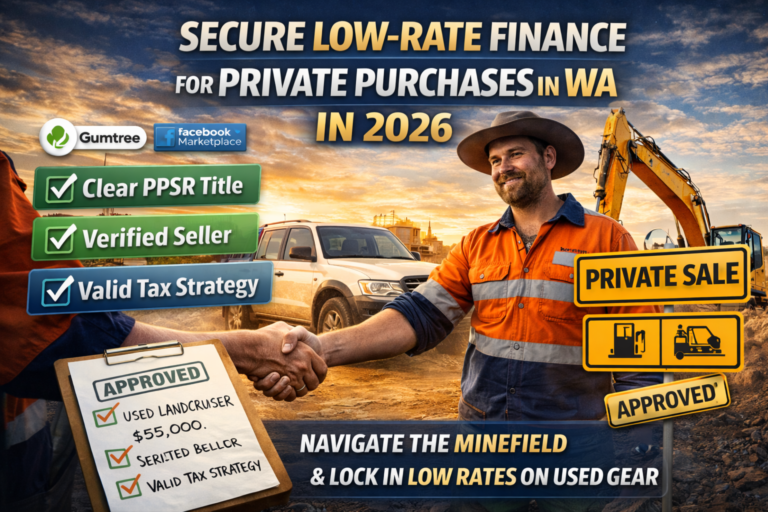
In the Western Australian heavy industry sector, the best deals aren’t found on a dealership floor in Welshpool. They are found on Gumtree, Facebook Marketplace, or through industry contacts—a contractor in Karratha offloading a 2018 Toyota Landcruiser or a civil company in Bunbury selling a low-hour excavator.
The financial reality is compelling: You save the dealer’s margin (often 10-15%) and get immediate delivery.
The financing reality is harder: Most major banks treat “Private Sales” with extreme caution. They view them as high-risk for fraud, stolen goods, or “phantom” assets. If you walk into a branch with a handwritten invoice from “Dave in Balcatta,” you will likely face a lengthy list of requirements or a flat decline.
Here is the technical breakdown of how to navigate the private sale minefield and secure Tier 1 rates for used assets in 2026.
1. The “Private Sale” Stigma: Why banks are nervous
To a lender, a dealership provides a layer of security. A dealer is a registered business with a physical yard and a reputation to protect. A private seller is just a person.
-
The Risk: The bank worries about “encumbrance.” What if Dave doesn’t actually own the excavator? What if he owes money on it to another lender? If your bank pays him, and then the other lender repossesses the machine, your bank is left with an unsecured loan.
-
The Solution: You need a lender with a “Private Sale Team.” Specialist asset lenders have internal departments dedicated to validating these transactions so they don’t have to rely on trust.
2. The PPSR Check: The “Golden Ticket”
Before you even agree on a price, you must perform a PPSR (Personal Property Securities Register) search.
-
What it is: A government database that tracks security interests over personal property (cars, boats, machinery).
-
The Deal Breaker: If the asset has an existing “charge” or “security interest” registered against it, you cannot settle.
-
Scenario: The seller says he owns the bobcat outright. The PPSR shows a registration from “Westpac.” This means he still owes money on it.
-
-
The Fix: We arrange a “Payout Letter” directly from his lender. We pay his bank first to clear the debt, and give him the remaining balance. This ensures you get “clear title.”
3. The Inspection Mechanism
In 2026, lenders have moved away from physical inspections for smaller assets, but for heavy machinery, they still need proof the asset exists.
-
Cars & Utes: Usually, photos of the VIN plate, odometer, and all four sides (geo-tagged) are sufficient.
-
Yellow Goods: For high-value items (>$100k), the lender may send a third-party valuer (like Redbook Inspect) to verify the serial numbers match the invoice.
-
Why this matters: This protects you as much as the bank. It confirms you aren’t buying a “rebirthed” or stolen machine.
-
To see which asset classes require physical inspections vs. digital verification, check our Asset and Equipment Finance services.
4. Vendor Identification (The “KYC” Check)
This is the step that slows most private sales down. The lender must “Know Your Customer” (KYC)—in this case, the seller.
-
The Requirement: The seller must provide a clear copy of their Driver’s License (front and back) and sometimes a Medicare card or Rates Notice.
-
The Friction: Private sellers can get defensive. “Why does your broker need my ID? I’m just selling a ute.”
-
The Explanation: We frame this as a safety check for them. It ensures the funds are going to the correct person and prevents identity theft. Once the ID is verified, the lender can release funds directly to their bank account.
5. Structuring the Loan: Tax Implications
Just because you are buying from a private seller doesn’t mean you lose your tax advantages. However, the GST treatment is different.
-
Private Seller (Not Registered for GST): If you buy a ute for $40,000 from a private individual, there is usually no GST on the invoice.
-
Consequence: You cannot claim a GST Input Tax Credit because you didn’t pay any GST.
-
-
The Finance Structure: You can still use a Chattel Mortgage, but you won’t get that “Quarter 1 Refund” boost. You will, however, still be able to depreciate the asset’s value over its useful life.
If the seller is a business (e.g., a plumber selling his old van), they must provide a Tax Invoice with GST. In this case, you can claim the GST back. Read our pillar guide on Chattel Mortgage vs. Hire Purchase to understand exactly how to structure the loan based on the invoice type.
6. The “Interposition” Option
If the bank is simply refusing to fund a private deal because the asset is too old or unique, we have one final lever: Dealer Interposition.
-
How it works: We find a friendly dealership to “buy” the asset from the private seller and immediately “sell” it to you.
-
The Cost: The dealer charges a fee (usually roughly $1,000 – $2,000) for handling the paperwork and statutory warranty risks.
-
The Benefit: The transaction becomes a “Dealer Sale” in the eyes of the bank, unlocking lower interest rates and easier approval terms.
Summary: Don’t Let the Bank Kill the Deal
Buying privately requires more due diligence, but the savings are real. The key is to have the finance approval before you negotiate the final price.
-
Get the Rego/VIN.
-
Run the PPSR.
-
Secure the Finance Approval.
We handle the PPSR checks, the vendor ID verification, and the payout letters internally, so you never have to have an awkward conversation about “clear title” with the seller.