
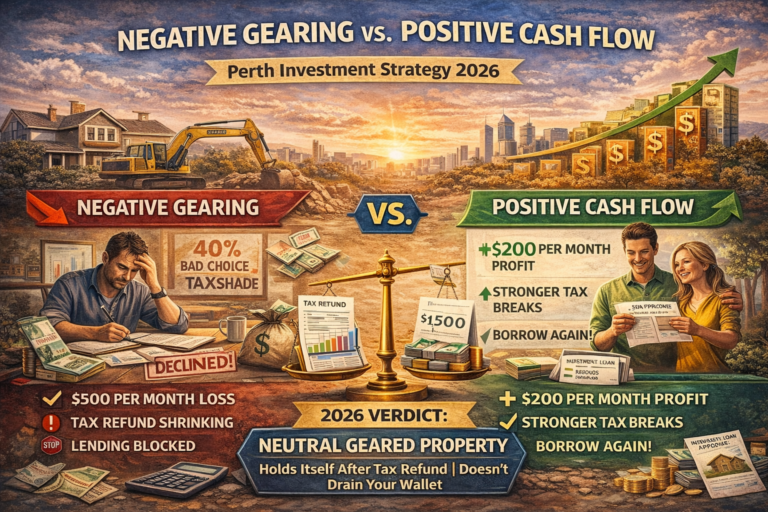
For decades, the Australian property strategy was rinse-and-repeat: Buy a loss-making asset, claim the tax back, and wait for the boom.
In 2026, that playbook is dangerous.
Two major structural shifts have occurred that arguably make Negative Gearing less effective and Positive Cash Flow more critical than at any point in the last ten years.
If you are a Perth investor looking to grow a portfolio—rather than just buy a single investment property—you need to understand the new math of “Serviceability Shading” and the “Stage 3 Tax Reality.”
Here is the technical breakdown of what actually works in the current WA market.
1. The “Stage 3” Tax Trap
Most investors haven’t updated their spreadsheets to reflect the full impact of the Stage 3 tax cuts that are now fully bedded in.
The Old Logic (Pre-2024): If you earned $120,000, you were in a 37% tax bracket. If you lost $10,000 on a rental property (negative gearing), the ATO handed you back $3,700. The government effectively subsidized 37% of your loss.
The 2026 Reality: Under the current tax brackets, that same $120,000 income attracts a lower marginal tax rate (30%).
-
The Math: Now, a $10,000 loss only triggers a $3,000 refund.
-
The Result: You are arguably $700 worse off per year for the exact same investment compared to the old tax regime.
The Takeaway: Losing money to save tax is mathematically less efficient in 2026. The “government subsidy” for your loss has shrunk. High-capital growth assets that bleed cash are now harder to hold, making the argument for positive cash flow (or at least “neutral gearing”) much stronger.
2. The “DTI Wall” (Debt-to-Income Ratio)
This is the hidden metric that stops investors at Property #2.
While you are focused on your deposit, the banks are focused on your DTI. APRA (the banking regulator) has heavily incentivized banks to limit lending to borrowers whose debt is more than 6 times their income.
How Negative Gearing Hurts You Here
If you buy a negative geared property, you are adding High Debt but Low Income to your application.
-
Example: You buy a $700k property in a “blue chip” suburb with a $400/week rent.
-
Bank View: Your debt spiked by $560k, but your income only crept up slightly. Your DTI ratio explodes, and the bank declines your next loan.
How Positive Cash Flow Saves You
If you buy a high-yield asset (e.g., a dual-key home or high-yield villa in an outer Perth growth corridor):
-
Example: You buy a $600k property renting for $750/week.
-
Bank View: The high rental income helps “wash its own face.” It adds income to the denominator of the DTI calculation, keeping your ratio lower.
Technical Note: Banks do not use 100% of your rental income. They “shade” it, usually counting only 80%. This means you need a gross rental yield of roughly 6.5% – 7% just to look “neutral” to a bank’s servicing calculator.
3. The 2026 Perth Yield Map: Where did the cash flow go?
In 2023/24, you could buy almost anywhere in Perth and get 6% yields. In 2026, after substantial price growth, those yields have compressed in premium suburbs.
The “Zone” Shift:
-
Inner Ring (Subiaco, Mt Lawley): Yields have dropped to ~3-4%. These are pure “Capital Growth” plays. Great for equity, terrible for borrowing power.
-
Middle Ring (Morley, Balcatta): Yields are hovering around 4.5%. This is “Negative Gearing” territory.
-
The “Yield Corridors”: To find the 6%+ yields required for a Positive Cash Flow strategy in 2026, investors are looking at:
-
Strategic Villas: Older 1990s villa complexes in infill suburbs where land value is high but strata fees are managed.
-
Outer Growth: Areas like Armadale/Kwinana (South) or Two Rocks (North) where rent prices have risen faster than purchase prices due to extreme vacancy shortages.
-
4. The Verdict: The “Hybrid” Approach
So, which strategy wins?
-
Go Negative Gearing if: You have a massive surplus income (e.g., household income $300k+), you have no intention of buying more than 1-2 properties, and you want to speculate on maximum asset appreciation in premium zones.
-
Go Positive Cash Flow if: You are building a portfolio. You need Property #1 to support the loan for Property #2. You are on an average income and cannot afford to fund a shortfall of $500/month.
The 2026 “Gold Standard”: Neutral Gearing
The smartest clients we see are aiming for Neutral Gearing. This means the property pays for itself (holding costs = rental income) after the tax refund is accounted for. It doesn’t put cash in your pocket, but it doesn’t take it out either. This preserves your lifestyle while you wait for the Perth market to do the heavy lifting on equity growth.
Don’t Trust Generic Calculators
Online calculators do not factor in “Rental Shading” or the specific credit policies of 2026 lenders. A property might look positive to you, but negative to a bank.
We can run a Portfolio Projection for you to show:
-
How a specific property impacts your borrowing power for the next one.
-
The real-world tax difference under the new Stage 3 brackets.
Book your Free Investment Strategy Consultation here.
For more details on how we structure loans for investors to maximize deductibility, visit our Investment Property Loan Services page.